CMS issued the memo (QSSAM-26-03) on March 30, 2026. Here’s what’s changed for hospital nutrition operations and what surveyors are looking for now
What is QSSAM-26-03?
QSSAM-26-03 is a memo released by CMS that is applied to hospital nutrition guidelines going forward.
The regulation hasn’t changed. Expectations have. The memo signals increased scrutiny around hospital nutrition and food service, with surveyors looking more closely at how hospitals demonstrate alignment.
For many food service departments this raises a practical question:
If a surveyor asked today, could you clearly demonstrate how your diets and menus align with current nutritional guidelines?
For most teams, that answer still depends on spreadsheets, binders, and knowledge that takes time to assemble.
A familiar challenge: survey readiness under operational strain
Federal nutrition guidance updates on a regular cadence. Disparate therapeutic diet manuals, printed menus, recipe cards, and the spreadsheets that track them often don't.
Each update triggers the same operational burden: manually cross-referencing new guidance against existing menus, and reconciling information across systems that don’t talk to each other.
For short-staffed teams, this creates a compounding problem. The same people responsible for daily food service operations are also responsible for maintaining survey-ready documentation, often without documented time or tools to keep both current.
Does QSSAM-26-03 apply to Critical Access Hospitals?
The disproportionate burden on Critical Access Hospitals
QSSAM-26-03 applies equally to hospitals and CAHs, but the operational realities are very different. Most CAHs run nutrition services without a full-time on-site RDN, relying instead on consulting dietitians, shared services, or part-time clinical support. Daily food service is managed by small teams focused on feeding patients well, not maintaining a continuously survey-ready paper trail.
As a result, the compliance burden created by evolving guidance falls disproportionately on already lean staff.
This isn't a failure of effort. It's a limitation of the tools food service departments have historically had. Most legacy systems were not designed to maintain continuous survey readiness as guidance evolves.
A system designed to adapt
Modern nutrition operations require more than periodic documentation updates. They require systems that stay aligned with policy in real time, and make that alignment easy to demonstrate on demand.
We built Banquet because food service departments deserve the same high-quality software support as the pharmacy or the lab.
Within Banquet, teams configure diets to reflect organizational nutrition standards and therapeutic policies. Rules can be defined at the meal or daily level, including minimums, maximums, and tolerances for each nutrient. For example, added sugars can be restricted at a diet level to make sure meals are in compliance with the guidelines.
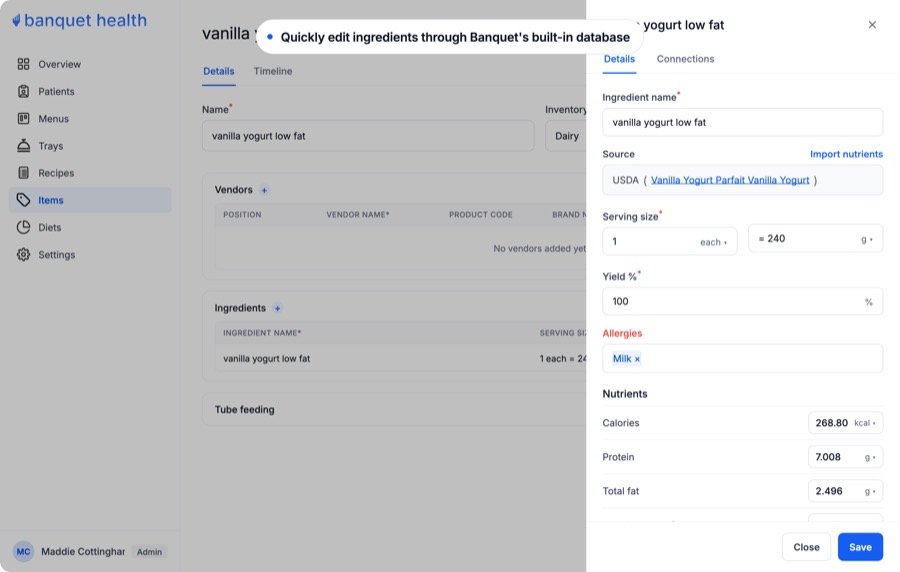
These rules don’t just live in documentation. They actively shape menu construction. Configurations can warn on non-compliant items or prevent ordering of them entirely, helping ensure that what is served stays aligned with policy in real time. Banquet automates ingredient updates across recipes so teams can roll out changes without manually reworking every dish, as shown in the video below:
Banquet was built so small teams, even those without dedicated IT or software administrators, can configure compliant diets, generate survey-ready documentation, and identify ingredient-level compliance issues in hours instead of weeks.
For consulting RDNs supporting multiple CAHs, oversight becomes scalable without requiring proportional time on site.
How do hospitals demonstrate compliance with the 2025-2030 Dietary Guidelines?
Survey readiness without the scramble
Banquet continuously tracks every diet change, tray event, and order as they happen, creating a complete audit trail without manual reconciliation.
Instead of assembling evidence of compliance after the fact, teams can demonstrate it instantly, whether for internal review or a surveyor request.
What previously required days or weeks of preparation becomes immediately accessible.
For already lean teams, this reduces one of the most time-consuming parts of survey readiness: proving what is already true operationally.
Built for what comes next
CMS guidance will continue to change. The teams best positioned for this environment aren’t the ones working faster to keep up. They’re the ones operating on systems that make compliance continuous, not episodic.
The value isn't in catching up with today's guidance. It's in being ready for whatever comes next.
Instead of reacting to audits, teams stay ready for them by default.
If you're rethinking how your nutrition program supports survey readiness while reducing strain on short-staffed teams, we'd love to talk.
Reach out at sales@banquethealth.com, and learn more about our product here.