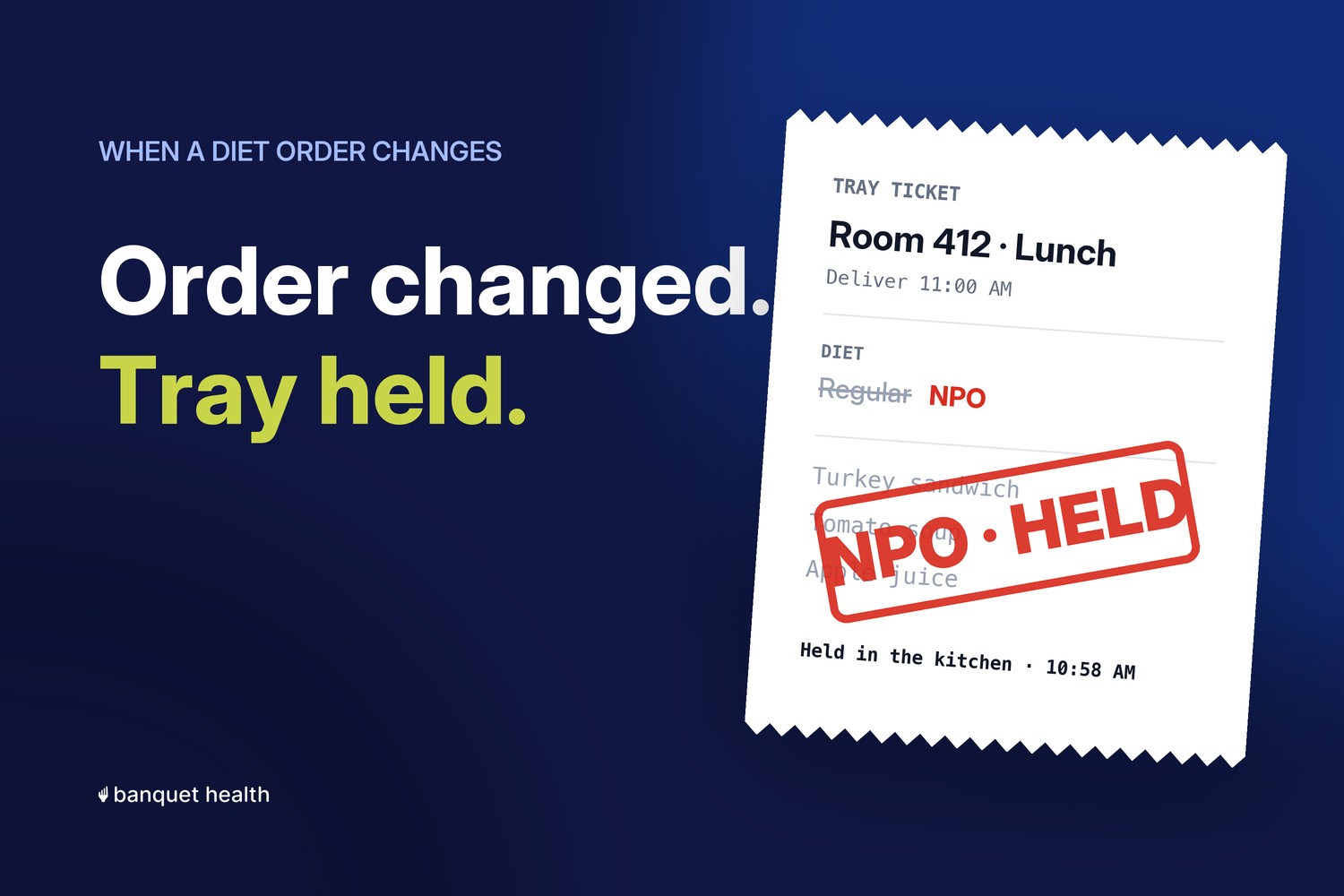
A resident on a GI service was on rounds at eleven in the morning when he realized a patient needed to be NPO. He physically ran down the hall to catch the meal tray before it got delivered.
That’s not a hypothetical. A gastroenterologist at a major academic medical center told us it happens all the time.
The order goes into the system, but the actual safety net catching the gap between the order and the tray is a resident sprinting to a room hoping they’re not too late.
Everyone assumes food service software is a diet office problem. It isn’t.
The people affected when a diet order and a meal tray don’t match are surgeons and GI doctors whose procedures get delayed or cancelled, cardiologists managing diet restrictions tied to a cardiac workup, and the clinicians making swallowing-safety decisions for at-risk patients every day.
None of them work in food service. All of them depend on food service software doing its job correctly.
There’s data behind this too. A study of hospitalized patients undergoing colonoscopy found that inadequate bowel preparation was associated with longer hospital stays and higher costs, subsequently summarized as roughly two additional hospital days and more than $8,000 in hospitalization costs.
Multiply that across the procedure rooms running in a hospital system every day, and a diet order slipping through the cracks stops looking like a food service problem.
It becomes a length-of-stay problem the whole hospital owns.
We built Banquet to catch that gap before someone has to run down a hallway to catch it themselves. When a diet order changes, we flag the conflict before the tray leaves the kitchen, not after it’s already in front of the patient.
If your hospital’s safety net for this is a person sprinting down a hallway, it’s worth asking who else in your building is quietly absorbing that risk.